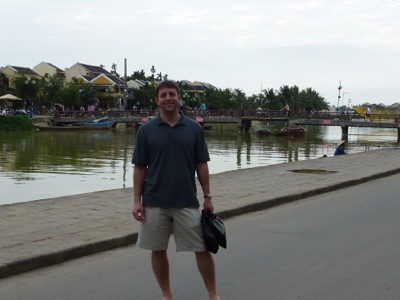
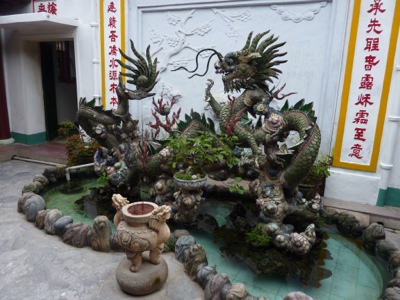
Today we toured the Mekong River Delta, a fertile region responsible for much of the country's rice, fruit, and fish. Our day was characterized by four modes of transportation. First, we took the car an hour and a half south of Saigon to the city of My Tho, where we boarded a small, but motorized, boat. At this section of the Mekong, the river is very wide and home to many fishing villages.
The water is fairly murky because all of the silt and sand being carried over 1000 miles and deposited here. We saw many barges carrying sand up river to be used to make cement.
There are many natural canals and small islands in Mekong, and as we entered one, I started to feel like I was at Disney World on Pirates of the Caribbean.
Our first stop was a honey bee farm, and Brian had the honor of holding a hive of bees. Don't we look at ease?
Next we boarded a mule-drawn ox cart for a short jaunt down the road to a fruit farm. There we had another pleasure of holding a python.
At the farm we sample some pineapple, dragon fruit, milk apple, mango, and jackfruit while listening to some live local folk music.
Next we boarded a very small, human-powered, sampan to navigate the narrow canals. We were really in the jungle now.
Along the way our guide caught some large river prawns. I also finally donned a typical conical hat (after continued urging from Brian throughout the trip).
We boarded our larger boat and then visited a local candy factory. Much to Brian's chagrin, they were making coconut candy (Brian hates coconut, which is very pervasive here).
After arriving back to Saigon, we visited the night market and had dinner at a large open air restaurant. For our friend Bill, you'll notice Brian is enjoying a local beer alongside his local fare.
Wednesday, January 11, 2012
Tuesday, January 10, 2012
Day 11 - Saigon, Vietnam
We arrived in Ho Chi Minh City in the early afternoon (most of the locals still call the city Saigon). We welcomed the 90+ degree heat, as it had been fairly chilly in the central and northern parts of Vietnam.
We walked around the city for a little bit and stopped for lunch at a good local restaurant (it's always a good sign when you see actual locals eating there, and not just tourists).
Note: If we haven't mentioned this yet, the cost for food on the trip has been extremely inexpensive. This meal was a grand total of $4 for both of our meals, which included a few courses (this has been the average lunch price the last few days). You can't get a McDonald's Happy Meal for that price. Even our 'extravagant' dinner in Hoi An a few nights ago with multiple courses and four beers cost a whopping $18.
In the evening we stopped at the famous Rex Hotel for drinks on the roof. Historically, the Rex was the focus for American social and military activities during the Vietnam War. On the roof, we had a great vantage point of the city and the horrible Saigon traffic below (this is typical for Saigon). Try driving on this road (Click here for video):
For dinner, we ate at a well-known Vietnamese barbecue place, Quan Nuong. We got to cook our own veggies and meat in the middle of the table. It was delish!
Monday, January 9, 2012
Day 10 - Hoi An, Vietnam
The next day we wandered through the market and Brian put his bargaining skills to work (get ready for a plethora of market pics).
Candy for Tet (lunar new year):
Pickles:
Dried fish to make fish sauce:
Fresh rice noodles:
Fruit, including dragon fruit, mangosteen, and rambutan:
Make shift restaurant:
Traveling restaurant:
We spent the rest of the day wandering around and relaxing on our river-front deck.
Candy for Tet (lunar new year):
Pickles:
Dried fish to make fish sauce:
Fresh rice noodles:
Fruit, including dragon fruit, mangosteen, and rambutan:
Make shift restaurant:
Traveling restaurant:
We spent the rest of the day wandering around and relaxing on our river-front deck.
Day 9 - Hoi An, Vietnam
We arrived to the small town of Hoi An in the early afternoon. First stop: a tailor shop. Hoi An has tons of tailors and is well known as a place to get clothes made cheaply (and quickly). Because we were only in town for a day and a half, we made this our first stop to allow enough time for alterations. Below is Brian getting measured for a suit.
Next, we stopped for lunch overlooking the Thu Bon river.
We had some Hoi An specialties: White Rose dumplings, Mi Quang, and Cao Lau.
Hoi An is a world heritage site because of its unique and well-preserved mix of Vietnamese, Chinese, and Japanese architecture. Hoi An was an important trading port from the 16th to 18th centuries luring traders from all over Asia and also Europe, and many of them built culturally diverse homes and temples.
We visited the Japanese Bridge, which was originally constructed in 1593 to connect the Japanese and Chinese quarters, and the House of Phung Hung, a house built in 1780 that has been the home to eight generations of the same family.
Next stop was the Chinese Phuc Kien Assembly Hall.
People were burning long incense for the new year
Hoi An is also know as the lantern city because of the many lantern shops and lanterns hanging in the street.
Sunday, January 8, 2012
Day 9 - Danang, Vietnam
We left Hue this morning and drove down the coast to Danang en route to Hoi An. The drive itself is was very scenic (it's supposed to be one of the most scenic drives in Vietnam). We drove over three mountains, by rice fields, and by beaches.
My Uncle Garey (dad's brother) is a Vietnam veteran who was stationed in Danang from May 1967 to May 1968. He was part of the 620th TAC squadron. I located the radar stations he manned on top of Monkey Mountain (in Danang). Unfortunately, the public is not allowed to drive up the mountain, as the radar stations are now currently in use by the Vietnamese military.
From the top of the mountain, my uncle could see the Tet Offensive as it was occurring below. His squadron's base camp was at the bottom of the mountain. Close by his camp was the Navy deep water peer where all of the dead from that area were shipped back to the United States. He recalled the large flat bed trucks passing by his squadron's entrance carrying the dead to the peer by the hundreds daily. These are the grim memories of war that stick with you your whole life (I can't even begin to imagine).
We traveled to the east side of Monkey Mountain and visited a new enormous pagoda that faces the ocean, Pho Da Pagoda. It features a 76 meter high lady buddah statue that looks out into the ocean. You can climb it to get great views of Danang and the coastline (Kim and I opted to take in our views from the bottom).
Next we went to the other side of Danang to Marble Mountian, passing by China Beach on the way. Marble Mountain is actually five small mountains. The main mountain is open to the public for climbing, so we climbed it.
Halfway up the mountain is a cave that was used as a Vietnamese hospital during the Vietnam war.
Kim relaxed at the halfway point while I climbed the rest of the way to the highest point of the mountain (it was quite a workout, but worth it).
By the way, if you ever need something carved out of marble, the town at the bottom of the mountain is the place to get it! Lots of marble shops and stone masons that will carve just about anything out of marble.
Subscribe to:
Posts (Atom)