We just so happened to be in Vienna on a Sunday, so we started off our day with Mass at Stephansdom. Stephansdom is a huge gothic cathedral in the center of Vienna, dating from the 1300s, its most distinct feature is its tiled roof.
After mass (in German) we wandered around the Inner Stadt (city center) along the main shopping streets of Kartner, Graben, and Kohlmarket and saw the baroque church Peterskirche. Vienna has quite the cafe society, and Austrians drink a lot of coffee. We stopped at Cafe Demel mid-morning for our first melange (kind of like a cappuccino), apple streudel, and sacher torte. Sacher torte is a dense chocolate cake made famous in Vienna because it was a favorite of one of the Hapsburgs.
After our snack, we headed to the Hofburg, the winter palace and imperial court of the Hapsburgs. From here they ruled the Hapsburg and later Austro-Hungarian empire until World War I. We took tours of the Kaiserapartments, the part of the palace where Emperor Franz Joseph and Empress Elizabeth lived, the Sisi Museum, and the Imperial Silver Collection.
Included in the ticket price were audio tours of each museum (Yippee!). Here's Brian looking super-enthused 45 minutes into the Imperial Silver Collection tour, as he listens to the story behind the 47th placesetting we've seen.
After the Hofburg, we wandered around the Ringstrasse (an inner ring around the city) to take in some architecture. We saw the Kunsthistoriches and Naturhistoriches museums, the Neueburg (the new wing of the Hofburg), the Volksgarten, the Burggarten, the Burgtheater, Parliament, the Univerisity of Vienna, and the Staatsoper (State Opera House).
In the afternoon, near a statue of Mozart in the Burggarten we stopped at our first Wurstelstand (think hot-dog stand but better). They have all kinds of sausages, such as frankfurters, bratwurst, burenwurst, currywurst, and even sausages stuffed with cheese. You can get them sliced or in a roll - but they don't just slice the bun open. They have a contraption that makes a hole through the center of the roll, then they drizzle some mustard inside and then slide the sausage in - quite an efficient bit of packaging.
Later in the afternoon we headed down to Karlsplatz to take in the baroque church Karlskirche, dedicated to the end of the plague in the 1700s. We capped off our night with a Mozart and Strauss concert. We heard Eine Kliene Nachtmusik and the Waltz of the Blue Danube, among other songs, performed by a string quartet.
The majority of today was dedicated to travel. Our ferry back to Athens last night didn’t get in until 1:15 am, so by the time we caught a cab downtown, checked-in, and got situated in the room, it was well after 2. Since we were very tired, we slept in until 10. After eating breakfast and checking out, we had about an hour and a half window to do something in Athens before we had to head to the airport to catch our flight to Vienna. I convinced Kim to go to the War Museum. It was close to the hotel and it was free.
The War Museum covers Greek history from ancient times until the after WWII. There are plenty of good visuals here, from weapons to war maps and replicas. However, I was hoping there would be more in-depth descriptions of historic battles, etc., and some of the captions were only in Greek (I kept joking with Kim, “This is all Greek to me”). I definitely could have spent longer than the hour or so we were there, but I’m not so sure Kim could have. Here I am in front of a Greek fighter and missile (both made in the USA, by the way).
Unfortunately, our flight to Vienna got delayed a few hours. We had hoped to have a nice Saturday evening catching dinner in Vienna and wandering around. However, by the time we made it to the hotel, which was well outside the city center, it was after 10 and we were exhausted from travel. We ate “dinner” in our room, which consisted of fruits and granola bars we picked up at the airport grocery store (yes, there was a nice little grocery store at the airport), then hit the sack to prepare for tomorrow’s sightseeing.
Santorini has the breathtaking views, but Mykonos has the beaches. The beaches are all white sand, no pebbles, and there are plenty to choose from - some small and more secluded, and others more party oriented. In general, Mykonos is known as more of a party island. The clubs start getting crowded around 2am and don't close until after 7 in the morning (true party goers sleep during the day). The beach close to our hotel, Platis Gialos, was a good beach in my opinion and on the relaxed side, which was nice.
There are buses and boats to get to other beaches and to travel into town. However, it is far easier to get around by renting a car, moped, or 4-wheeler (many of the visitors rent mopeds). Unfortunately, they wouldn't let me rent a moped without a motorcycle license, so we opted for the 4-wheeler. This turned out to be a great decision . . . we had so much fun!
We nicknamed our 4-wheeler the "Silver Slug" due to its inability to get up hills, but it was perfect for riding around most of the island. We visited the town of Ano Mera in the center of the island and a few other beaches (Paraga and Paradise . . . both good beaches). Below is a picture of us at Paradise Beach, the "party beach." Unfortunately, we didn't make it to Super Paradise Beach, which is supposed to be even crazier than regular Paradise Beach. Mykonos Town, the main town on the island, is mostly pedestrian, full of shops, cafes, creperies, bars, and restaurants. The vast network of streets/alleys is a huge maze, making very easy to get lost. We had fun in Little Venice last night (we also caught a sunset here).
Additional Notes: - This is an example of an authentic Greek Gyro. Note the massive amount of filling, as well as the meticulously placed french fries:
Santorini - A vacation within our vacation. There's not much to say about it, except that it was beautiful and we had a great time, so we'll let the pictures do the talking. In brief, we stayed in the main town of Fira, and ventured to Perissa (a black sand beach and our favorite), the Red Beach (red sand obviously), and the western-most town of Oia for sunset. We soaked in a lot of views (we had a great view of the Caldera from our hotel), watched a lot of beautiful sunsets, and ate some tasty Greek food. We give a special recommendation for Nikolas, a great taverna in Fira - no view, but the best food in town for the money (see the picture of Brian eating below).
Additional thoughts/notes: - Greeks love their Lady Gaga and Katy Perry. - Greeks also love their Frappes. So does Kim (see picture of Kim below drinking probably her 20th Frappe since entering Greece)
Kim: Today was supposed to be even hotter than yesterday, so to beat the heat, we hit the Acropolis and surrounding sights first thing in the morning. We started at the Theater of Dionysis, where the first works by the famous Greek playwrights Sophocles and Aesceylous were performed during the festival of Dionysis, the God of wine, inebriation, and partying in general (that’s Brian sitting in the seats).
Then we entered the Acropolis (the large fortification on top of the hill) through the Propyleia, or gate to the city. Near the Propyleia is the Temple of Athena Nike, however, they had removed the temple piece by piece to do restoration work and were currently in the process of putting it back together again.
In the center of the Acropolis is the Parthenon, the main temple dedicated to Athena, protector of Athens. Different types of structures preceding the Parthenon had existed on the Acropolis since Mycenaean times, but the current structure dates from the 5th century B.C. The Parthenon is the largest example of a Doric temple in the world, although it also began to incorporate some Ionian elements. Its proportions were modified slightly from a perfect rectangle so as to appear in perfect proportion from every angle (below is the view from the back of the Parthenon).
The structure was built very soundly, but is in its present condition for several reasons. First, earthquakes. Second, explosions during a Venetian raid on the Ottomans in the 1600s (the Ottomans kept their gunpowder in the Parthenon). And finally, various archeological “lootings” throughout the years. Even though only a fraction of the temple remains, it is still extremely impressive.
The final site on the Acropolis was the Erectheion, a temple to some other gods. Most notable about this temple is the porch of the Caryatids, a porch with six statues of women as columns.
After the Acropolis, we wound our way down through the Ancient Agora, a site for trading, politics, and meeting for the ancient Greeks. Hungry from our climb, we sampled some souvlaki for lunch. It was delicious!
Needing relief from the 104 degree heat, we decided to spend the afternoon in the New Acropolis museum. The museum just opened in June, and houses many of the artifacts found during excavations of the Acropolis and many statures and sculptures reconstructed from the ruins. One of the coolest things about the museum is that much of the floor is glass, allowing you to see below to the ancient ruins discovered during construction of the museum.
On our way home, we had our first gelato of the trip and walked by the Temple of Zeus. We also caught the changing of the guard at the Greek Parliament at 5pm. The soldiers do a weird kind of march and their uniforms are . . . interesting to say the least. Check out those pom-poms on their shoes.
Later in the evening, we met a friend of mine from business school and some of his friends for dinner in Kiffisia. We handed total control of ordering over to them, and everything was delicious. The ordering process itself was comical to us as observers. Imagine seven Greeks, shouting haphazardly to each other and the waitress, in Greek, for approximately 10 minutes. Somehow the waitress got everything correct. For dessert, we tried a new favorite, Loukemades, fried dough soaked in honey. Yum!
Kim: After a long-lasting love affair with Egypt (note sarcasm), today we were thankful to fly to Athens, Greece. First sign that we were no longer in Egypt: no one was smoking in the airport. Second sign: traffic lanes on the roads (that cars actually stayed in). However, one thing that did not change was the temperature. Athens is in the middle of a heat wave, and it was close to 100 degrees today. Nevertheless, we settled in at our hotel (after a minor bus hiccup), and set out to enjoy the city.
Since hosting the Olympics, Athens has cleaned up and improved its public transportation system, and we took full advantage of it while we were here. We took the metro down to near the Acropolis and took a nice stroll on a pedestrian walkway that encircles the Acropolis for 3km. Then, around dusk, we hiked up to the top of Fillapapou Hill (we were more fit for this hill than the one in Istanbul). The views of the city were amazing, and the hill provided a great vantage point for seeing the Parthenon from a distance at eye-level.
Click the parorama thumbnail below for a larger picture:
After soaking in the views, we hiked down and strolled through the shops in Monastiraki to kill time before dinner (which doesn’t happen until 9 or 10pm in Greece). We had some delicious meze in Plaka, including our new favorite, Saganaki, a kind of hard cheese that is fried. After dinner, we leisurely walked back to our hotel and finally got a good night’s sleep to prepare us for our full day of sightseeing tomorrow.
We got up at 5:30am this morning to do our tours before the heat of the day. I still was not feeling 100%, as I had been bed-ridden half of yesterday and was still a little dehydrated (the Pharaoh really showed me who was boss). Luckily, before the trip we got strong prescription antibiotics for just this kind of thing, which I started taking yesterday to help kick it. I decided I would at least try and do some of the tour, and if I felt bad, we would skip the lesser sights.
Our guide took us to the Valley of the Kings first. The history: During the Old Kingdom, kings buried themselves inside the pyramids. This turned out to be a bad idea. The pyramids were basically huge signs for all grave robbers saying, “please come steal me and all my treasures.” Starting with the New Kingdom, Kings got very secretive about their burial spots. Instead of putting their tombs inside a pyramid, they were buried in a mountain that was shaped like a pyramid just west of the Nile in what was then Egypt’s capital, Luxor. This is now known as the Valley of the Kings. Pretty much all of the kings in the 18th – 20th dynasties were buried there (62 tombs have been discovered, some yet to be found). The kings were so secretive about their place of burial that only a few select priests and the workers who built the tombs knew about the locations, and the workers were never allowed to leave this area for generations. Unfortunately, it wasn’t very long after the 20th dynasty before the tombs were discovered by grave robbers anyway, which is why most of the tombs have no treasures in them today. King Tut’s tomb wasn’t discovered here until the 1920s, and was filled with massive treasures (now in the Egyptian Museum). The latest tomb discovery was 3 years ago, and there are more tombs to be found.
Of the 62 tombs, around 10 are opened to the public. Your ticket only gives you a choice of 3. Our guide, Ahmed, told us his favorites, so we went to those. There are pretty impressive drawings and stories on the walls, giving much insight to the religion and Gods of that time. Overall, the Valley of the Kings is a definite must-see in Luxor. (We don’t have any pictures because they are not allowed to be taken inside the tombs.)
Next we went to the Temple of Hatshepsut, which looked much different than the other temples from that time, with multi-level terraces (picture below).
After that, we visited an Alabaster factory. Many of the sarcophagi throughout the Kingdoms were made of alabaster, and all of the alabaster came from Luxor. This factory has been handed down for generations, and they get their alabaster rocks from just 100 meters away. Below is Kim carving an alabaster pot.
I was still feeling ok at this point, so we decided to go ahead and visit the Valley of the Queens. The Valley of the Queens was not just for tombs of Queens, but for children, wives, mothers, and nobles. One of the tombs had a mummified fetus in it. That was probably the highlight for me.
We then stopped by the Colossi of Memnon, then headed back to our hotel to relax and beat the heat (and in my case, get well) the rest of the afternoon. As we were hanging around the pool later, we were asked to be in a promo for the Sheraton hotel website. They sat Kim and I at a table with fake cocktails and took lots of video of us smiling and having fake conversations and watching the sunset over the Nile. So I guess that was our 15 seconds of fame… you may see us on the Sheraton Luxor website in about 2 -3 months!
We are looking forward to Greece… we fly to Athens at 8 tomorrow morning (another morning of getting up early).
Additional notes/thoughs:
- Luxor is more our speed… we definitely prefer it to Cairo. Laid back, no traffic, and seems safer/cleaner. Its population is only 400,000 compared to Cairo’s 20 million.
- More on driving in Cairo: We just heard a really good Rick Steve’s quote: “Cars stay in lanes in Cairo like rocks in an avalanche.” Perfect analogy.
- As with Cairo, getting a guide for Luxor is highly recommended.
- Don’t get into an argument with an Egyptian over who was the best King. I told our guide that I heard Ramses II was the best King, and he almost took it personally. He said, “Don’t even get me started….” If you were wondering, he is a die-hard Thutmose III fan (and yeah, I’ll agree that taking over 350 cities without losing a battle is a decent resume).
- I most likely got sick from eating tomato our last night in Cairo. Our guide said that no one in Egypt eats lettuce or tomato for this reason (restaurants either do not wash the lettuce/tomato or they wash them with the contaminated tap water).


 In the afternoon, near a statue of Mozart in the Burggarten we stopped at our first Wurstelstand (think hot-dog stand but better). They have all kinds of sausages, such as frankfurters, bratwurst, burenwurst, currywurst, and even sausages stuffed with cheese. You can get them sliced or in a roll - but they don't just slice the bun open. They have a contraption that makes a hole through the center of the roll, then they drizzle some mustard inside and then slide the sausage in - quite an efficient bit of packaging.
 We capped off our night with a Mozart and Strauss concert. We heard Eine Kliene Nachtmusik and the Waltz of the Blue Danube, among other songs, performed by a string quartet.
 Unfortunately, our flight to Vienna got delayed a few hours. We had hoped to have a nice Saturday evening catching dinner in Vienna and wandering around. However, by the time we made it to the hotel, which was well outside the city center, it was after 10 and we were exhausted from travel. We ate “dinner” in our room, which consisted of fruits and granola bars we picked up at the airport grocery store (yes, there was a nice little grocery store at the airport), then hit the sack to prepare for tomorrow’s sightseeing.
 Mykonos Town, the main town on the island, is mostly pedestrian, full of shops, cafes, creperies, bars, and restaurants. The vast network of streets/alleys is a huge maze, making very easy to get lost. We had fun in Little Venice last night (we also caught a sunset here).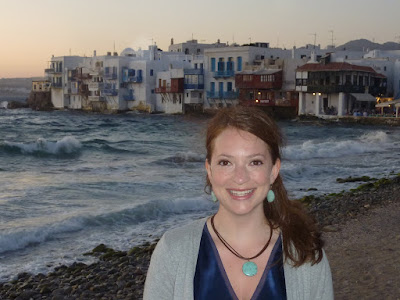


 The structure was built very soundly, but is in its present condition for several reasons. First, earthquakes. Second, explosions during a Venetian raid on the Ottomans in the 1600s (the Ottomans kept their gunpowder in the Parthenon). And finally, various archeological “lootings” throughout the years. Even though only a fraction of the temple remains, it is still extremely impressive.


 As we were hanging around the pool later, we were asked to be in a promo for the Sheraton hotel website. They sat Kim and I at a table with fake cocktails and took lots of video of us smiling and having fake conversations and watching the sunset over the Nile. So I guess that was our 15 seconds of fame… you may see us on the Sheraton Luxor website in about 2 -3 months!